Jews and Their Neighbours: Life on the Soviet Borderland in a Time of Change, 1939–1941
The project aims to study forced Sovietisation politics in the USSR Western borderlands (Western Belorussia) from autumn 1939 to summer 1941. It also examines a broad socio-economic and ethno-cultural context of creating "the new Soviet society". The final product of the project will be a monograph
The project aims to study the process of Sovietisation and its impact on the Jewish population of the western borderlands of the USSR between autumn 1939 and summer 1941. This will be examined in a broad socio-economic and ethno-cultural context. The geographical scope of the study is the border area defined by the Soviet government as Western Belorussia, which became part of the Soviet Union (on 2 November 1939, the official name was changed to the “Western Regions of the BSSR”).
The study takes into account the strategic importance of these territories for the Soviet Union between 1939 and 1941. This appeal to the geopolitical focus enables a fresh perspective on the origins, objectives, and consequences of Soviet policy on the western frontiers. The special border status and administrative isolation of Western Belorussia enables us to view the region as a geographical micro-model of Soviet policy along the western borders. The region can be considered a geographical micro-model of the Soviet state. The eventful chronological period of 1939–1941 allows us to construct a temporal model of the socio-political mechanisms of the Soviet state. A temporal model of the socio-political mechanics of the process of “creating a new Soviet society”, which crystallized in the USSR during the pre-war period of the 1920s and 1930s, can be constructed.
The overarching research question that will be addressed in this book can be articulated as follows: How did the Soviet authorities attempt to sovietise the population of the western frontier between 1939 and 1941, and what impact did this forced policy have on local residents, particularly the Jewish population?
The final product of the project will be a monograph entitled “Jews and Their Neighbours: Life on the Soviet Borderland in a Time of Change, 1939–1941”.
The project leader is Dr. Yanina Karpenkina — PhD in History, Associate Professor at the Faculty of Humanities, National Research University Higher School of Economics.
The project is carried out with the financial support of Alexander Klyachin.
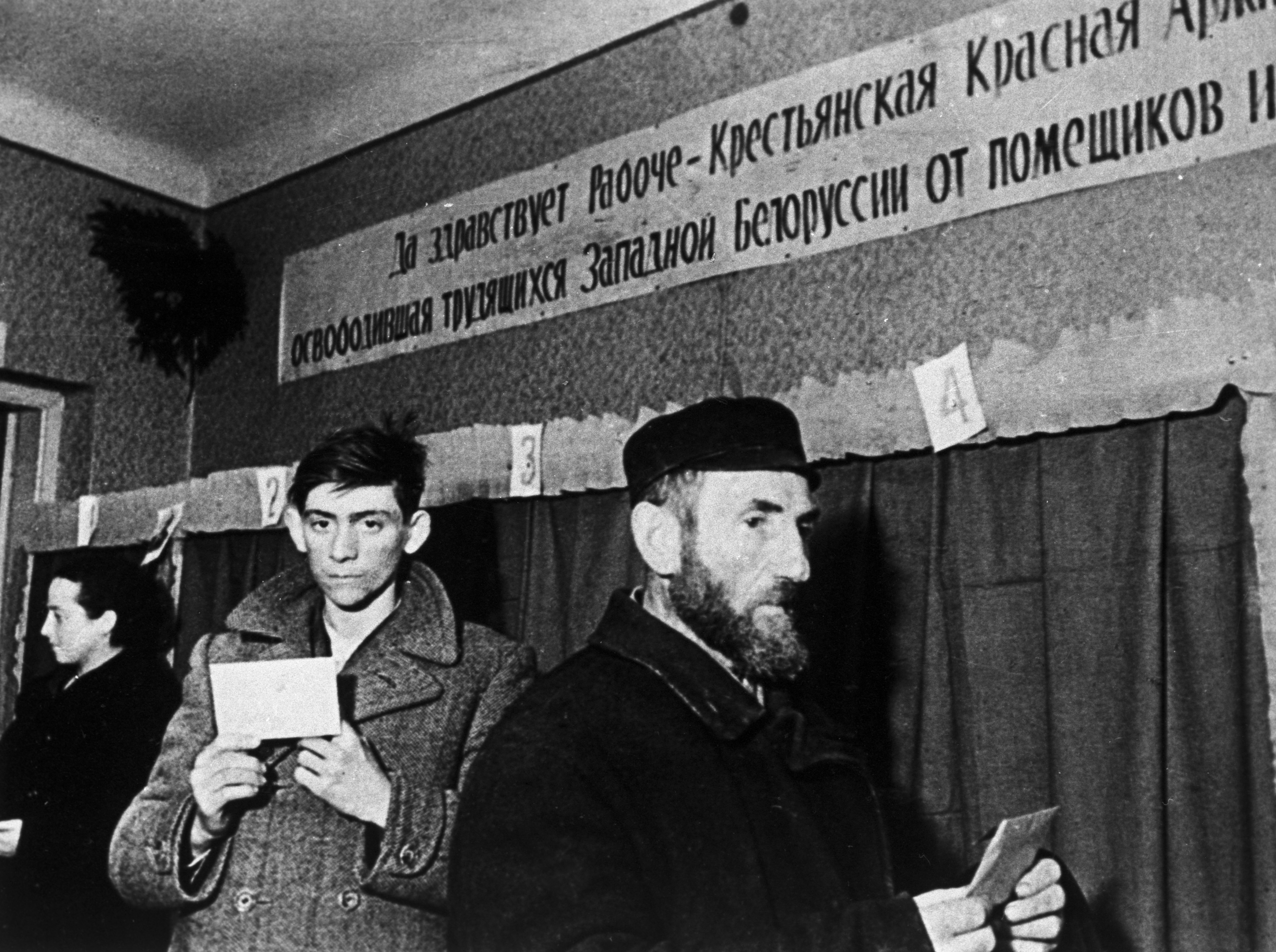
Image: the elections to the People's Assembly of Western Belorussia, Bialystok. 1939. Storage location: Belarusian archive of cine-photo-phono documents, photo No. 0-18377.