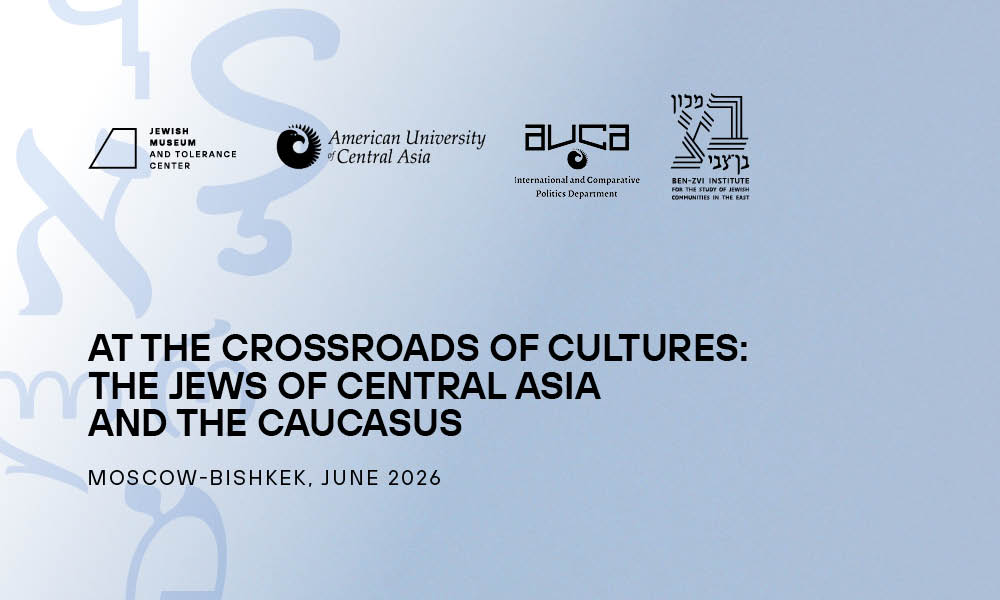
IV International Conference «At the Crossroads of Cultures: The Jews of Central Asia and the Caucasus»
Free
The 4th International Conference devoted to the interaction and mutual influence between various Jewish groups and their neighbors of other ethnicities and confessions in Central Asia and the Caucasus.
The conference will take place in Moscow on June 2, and in Bishkek on June 4 – 6, 2026.
Cinema Hall
11:15 – 11:30 MSK (14:15 – 14:30 BSHK/ UTC+6) | Conference Opening
11:30 – 13:30 MSK (14:30 – 16:30 BSHK) | Mountain Jews — Part 1
Moderator: Svetlana Amosova
Ekaterina Norkina (St. Petersburg State University, St. Petersburg)
"The Question of the Mountain Jews" in the offices of the Caucasian administration in the late 19th and early 20th centuries (ru)
Vladimir Kolesov (independent researcher, Krasnodar)
On the "Tukhum" Endogamy of the Mountain Jews (ru)
Mikhail Vasilyev (Institute of Oriental Studies RAS, Moscow)
Epigraphic sources for the Mountain Jewish Anthroponymy in the 19th–20th centuries (ru)
Semyon Padalko (St. Petersburg State University, St. Petersburg)
The "Mozdok Pastoral": The Life of Mountain Jews on the Periphery of Southern Russia (ru)
13.30 – 14:30 MSK (16:30 – 17:30 BSHK) | Break
14:30 – 16:30 MSK (17:30 – 19:30 BSHK) | Mountain Jews — Part 2
Moderator: Elena Fomenko
Daria Butseva (Russian State University for the Humanities; Jewish Museum and Tolerance Center, Moscow)
The Legend of the Chopped Book: Between Historical Epic and Family Tradition (ru)
Lyubov Solovieva (Institute of Ethnology and Anthropology RAS, Moscow)
Drawings by Artist Alexander Kornoukhov from Krasnaya Sloboda (ru)
Arusyak Agababyan (independent researcher, Krasnodar)
"Preserving the Language, Inventing the Tradition": Juhuri Festivals as a Source for Studying the Vitality of the Mountain Jews' "Native" Language (ru)
Elizaveta Yakimova (Institute of Oriental Studies RAS, Moscow)
The Ethos of Conflict as a Factor of Identity among Jews from Azerbaijan in Israel (ru)
16:30 – 17:00 MSK (19:30 – 20:00 BSHK) | Сoffee Break
17:00 – 18:00 MSK (20:00 – 21:00 BSHK) | Bukharan Jews
Moderator: Vladimir Kolesov
Evgenia Shanskaya (communications agency MAAS, Moscow)
The role of the merchant class of Bukharan Jews in the modernization processes of the Russian Empire in the territory of the Turkestan Governorate-General (ru)
Tatiana Emelianenko (Russian Museum of Ethnography, St. Petersburg)
"Keepers of Antiquities": On the Features of Traditional Culture and Self-Awareness of the Bukharan Jews (ru, online)
June 4. American University of Central Asia (Bishkek)
MakerSpace CH
10:30 – 11:00 BSHK (7:30 – 8:00 MSK) | Conference Opening
Welcome words by Dr. Timothy Edward O'Connor, President of the American University of Central Asia
11:00 – 13:00 BSHK (8:00 – 10:00 MSK) | Jews of Afghanistan
Moderator: Chen Bram
Ahmad Azizy (Oriental Institute of the Czech Academy of Sciences, Prague)
From Maḥalla-gardī to Monopolies and back – A Jewish Merchant’s Struggle in Modernizing Afghanistan, 1920s–1940s (en)
Christoph Hopp (University of Potsdam, Potsdam)
The 1913 Murder of Mullah Agajan Cohen and the Historiography of Afghan Jewry (en)
Zeev Levin (Ben-Zvi Institute, Jerusalem)
Digital Memory and the Preservation of Vanishing Communities — The Case of Afghan Jewry and the Afghanim Web Archive (en)
Thomas Loy (Oriental Institute of the Czech Academy of Sciences, Prague)
Herati Jews — Between Afghanistan, Iran, and Russian Turkestan (en)
13:00 – 14:00 BSHK (10:00 – 11:00 MSK) | Break
14:00 – 15.30 BSHK (11:00 – 12:30 MSK) | Jewish languages
Moderator: Thomas Loy
Dan Shapira (Bar-Ilan University, Tel Aviv)
Why the Jews of Central Asia / "Bukharan Jews" spoke Eastern Persian (and not some other Iranian language)? (en, online)
Alexey Lyavdansky (HSE University, Moscow), Pyotr Berlovich (independent researcher, Warsaw)
Lexical and Phraseological Hebraisms in the Neo-Aramaic Dialect of the Jews of Salmas (en, hybrid)
Murad Suleymanov (INALCO, Paris), Amin Yakubov (independent researcher, New York)
How English is Juhuri? Grammatical Copies in the Speech of Judaeo-Tat Heritage Speakers in the United States (en)
15:30 – 16:00 BSHK (12:30 – 13:00 MSK) | Сoffee Break
16:00 – 17:30 BSHK (13:30 – 14:30 MSK) | Mountain Jews — Part 3
Moderator: Ekaterina Norkina
Ksenia Viktorova (The European University at Saint Petersburg, Saint Petersburg)
The Kaitag Educators of the 1920s–1930s and the Kaitag Dialect of Juhuri (ru)
Svetlana Amosova (Institute of Slavic Studies RAS; Jewish Museum and Tolerance Center, Moscow)
The Wedding Ritual of the Mountain Jews in the Late Soviet Period (ru)
Elena Fomenko (Jewish Museum and Tolerance Center; HSE University, Moscow)
Digital Analysis of Oral History: Statistical Patterns in the Corpus of Interviews from Pyatigorsk (ru)
June 5. American University of Central Asia (Bishkek)
MakerSpace CH
11:00 – 13:00 BSHK (8:00 – 10:00 MSK) | From West to East
Moderator: Zeev Levin
Chen Bram (Jerusalem Multidisciplinary College; The Hebrew University of Jerusalem, Jerusalem)
Jews and Their Neighbors in Provincial Georgia’s Small Towns during the Late Soviet Period (en)
Alya Kedrenovskaya (Rezo Gabriadze art Foundation, Tbilisi)
Memories of the Jewish Quarter of Kutaisi in the Works of Rezo Gabriadze. Characters and Prototypes (ru)
Irena Vladimirsky (Achva Academic College, Be'er Tuvia)
No One Else's Misfortune Exists: The Activities of the Harbin Public Committee for Famine Relief in a Single Document (ru)
Ablet Kamalov (Turan University, Almaty)
Jews in China and East Turkestan: The History and Fate of the Community (ru)
13:00 – 14:00 BSHK (10:00 – 11:00 MSK) | Break
14:00 – 16:00 BSHK (11:00 – 13:00 MSK) | Jews in Central Asia in the 20th century — Part 1
Moderator: Nargiza Muratalieva
Olga Fataeva (Samarkand Regional Museum of Local Lore, Samarkand)
From the Cultural Life of Bukharan Jews in Uzbekistan in the First Half of the 20th Century (Based on Documents from the Samarkand Regional Archive) (ru)
Yanina Karpenkina (HSE University, Moscow)
"The Alien East": Constructing the Image of Central Asia in the Testimonies of Polish Jews (1941–1942) (ru)
Ekaterina Belkina (Institute of Oriental Manuscripts RAS; St. Petersburg State University, St. Petersburg)
The Leningrad School of Hebrew Studies in the Evacuation in 1942–1945 (ru)
Vladislav Tyurin (HSE University, Moscow)
Those Who Did Not Return: The Scale and Causes of Evacuated Jews Settling in the Soviet Republics of Central Asia (ru)
16:00 – 16:30 BSHK (13:00 – 13:30 MSK) | Сoffee Break
16:30 – 18:30 BSHK (13:30 – 15:30 MSK) | Jews in Central Asia in the 20th century — Part 2
Moderator: Ablet Kamalov
Altynay Mukhambedyarova (Turan University, Almaty)
The Jewish Community of Almaty: Historical Evolution, Socio-Structural Transformation, and the Role of Intellectual Elites (Based on L. Greenberg's Approach) (ru)
Askar Dzhumashev (Karakalpak Scientific Research Institute of Humanities, Nukus)
Vladimir Karvasarny — One of the Founders of the Energy Industry of Karakalpakstan (ru)
Irina Sinepupova (Nazarbayev University, Astana)
"...it became impossible for Jews and Kazakhs to live": Alexander Zhovtis (1923–1999) as a Chronicler of the Kazakh Cultural environment (ru)
Yevgeniy Davydov (Nazarbayev University, Astana)
The Soviet Jewish Identity of Yevgeniy Brusilovsky (1905–1981) (ru)
18:30 – 19:00 BSHK (15:30 – 16:00 MSK) | Conference Closing
Program
02 June 2026 (11:15)
04 June 2026 (10:30)
05 June 2026 (11:00)
CONTACTS
- E-mail: rc@jewish-museum.ru
- Phone: +7 (495) 645-05-50
- Our address: Moscow, st. Obraztsova, 11, building 1A
- Schedule:
Sunday — Thursday: noon — 10 p.m. (last entry: 9 p.m.)
Friday: 10 a.m. — 3 p.m. (last entry: 2 p.m.)
Closed: Saturday and Jewish holidays